

Artificial intelligence isn’t a magic switch for manufacturing, but it is reshaping how injection molding projects move from design to production. Instead of relying solely on intuition and trial-and-error, engineers now have tools that analyze geometry, predict material behavior, and flag risks earlier in the process. On the floor, AI can stabilize cycles, sharpen inspection, and even anticipate equipment wear. The result isn’t an entirely new way of molding, but rather a set of practical improvements that reduces surprises and supports better outcomes.
Early Design Decisions
The earliest design choices often set the limits for performance and cost. AI-assisted design for manufacturing (DFM) reviews help teams evaluate part geometry and historical run data before a tool is ever cut. Thin walls, knit line exposure, or draft concerns can be flagged alongside moldflow simulation, providing clearer options for refinement. Engineers can compare gate placement strategies, rib structures, or material combinations in multi shot programs, making design adjustments that support both cosmetic appeal and reliable molding. The payoff is fewer late-stage engineering changes, faster approvals, and validation cycles that start with a shorter problem list.
Material Selection with Real-World Insight
Material datasheets provide useful mechanical properties, but they rarely predict how a resin will behave in production. AI models trained on historical processing data can evaluate fill pressure, cooling behavior, warpage tendencies, or even decoration compatibility. This helps narrow choices between resins that look similar on paper but perform very differently at scale. For high-volume consumer goods or medical components where repeatability is critical, that insight can be the difference between a resin that meets spec and one that continuously creates headaches.
Process Optimization Without the Guesswork
Once a mold is running, AI excels at recognizing patterns in machine data. Parameters such as press tonnage, screw position, melt temperature, and cavity pressure can be compared against metrology results to uncover processing windows with the greatest capability. Instead of making incremental adjustments, process engineers can focus on the variables that truly influence part quality. Two areas often see quick benefits: cycle time reductions that trim seconds from each shot without raising scrap rates, and dimensional stability that protects capability indices even as tools age.
Smarter Vision Systems
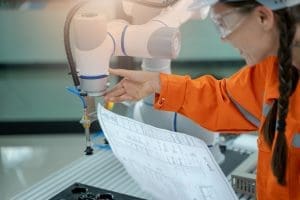
While traditional inspection relies on fixed rules like “reject if scratch > X,” AI vision learns the difference between a swirl that’s cosmetic and a flow line that signals a fill problem. That reduces either-or choices between over‑rejecting good parts and letting defects through. It also shrinks the “gray area” where operators need to stop the cell and ask for a call.
Predictive Maintenance
Preventive maintenance schedules based purely on time are gradually giving way to condition-based models. AI can monitor signals such as current draw, thermal response, or clamp force and spot trends that point to a component drifting toward failure. The same approach applies to mold health, where ejector load, cycle force profiles, or cooling line temperature maps reveal early signs of sticking, vent clogging, or fouling. Acting on those signals prevents costly downtime and keeps scrap under control.
Scheduling, Energy, and Inventory Balance
AI is also beginning to influence decisions beyond the press. Smart scheduling systems account for due dates, resin availability, tool changeovers, and even utility costs. Energy-aware planning can shift certain jobs away from peak hours without jeopardizing delivery. For programs with multiple SKUs, AI helps align resin, labels, and packaging so finished goods flow smoothly to shipping.
Electronics and PCBAs Inside the Mold
Integrating electronics into molded parts isn’t new, but AI makes the process more reliable. Insert molding PCBAs, encapsulating sensors, or overmolding RFID components involves balancing heat flow, placement accuracy, and traceability. AI contributes by:
- Thermal and mechanical modeling that prevents overheating solder joints or stressing delicate components.
- Improved placement accuracy when robots insert PCBAs or threaded inserts near sensitive circuitry.
- Inspection beyond the board to confirm label registration, antenna orientation, or window clarity.
- Traceability that links cavity and cycle IDs with PCBA serial numbers to create a complete product genealogy.
Common Use Cases
Adoption is most visible in industries where consistency and integration matter most. Wearables and medical devices often require soft-touch overmolds on rigid housings, where both material pairing and sterilization compatibility are essential. Consumer and industrial enclosures with integrated buttons, light pipes, or inserts near circuitry also benefit from AI-supported process control. RFID or NFC overmolding for authentication, asset tracking, or smart packaging represents another growing application. Even kitted assemblies that combine molded parts, PCBAs, and hardware into a single SKU gain from AI-assisted planning and inspection.
Where AI Fits – and Where It Doesn’t
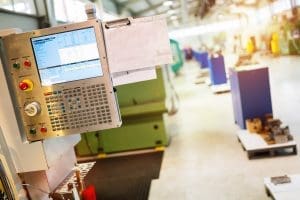
AI can streamline decisions, stabilize processes, and reduce risk, but it does not replace the fundamentals. Toolmakers still rely on craftsmanship to polish steel, adjust venting, or eliminate gloss mismatches. Process discipline remains critical, from validation protocols to documented controls. And collaboration between engineers, operators, and supply chain partners still drives the best results.
The Road Ahead
AI’s role in injection molding is expanding steadily, with its greatest impact found in targeted applications such as design reviews, process tuning, vision inspection, and predictive maintenance. For teams exploring adoption, the most effective approach is to start small: define the outcome that matters most – shorter validation cycles, less scrap, or more consistent output – then apply AI to a single step where variables are rich and measurable. Feeding results back into the system builds knowledge that compounds with every production run.
What’s clear is that AI won’t replace the fundamentals of molding, but it is becoming a valuable tool to support them. Toolmakers, engineers, and operators still provide the experience and discipline that shape successful programs. With AI assisting in the background, those fundamentals become stronger, decisions come faster, and production grows more resilient. For manufacturers considering next steps, the opportunity isn’t in chasing every new technology at once; it’s in combining proven practices with smart data-driven support.