
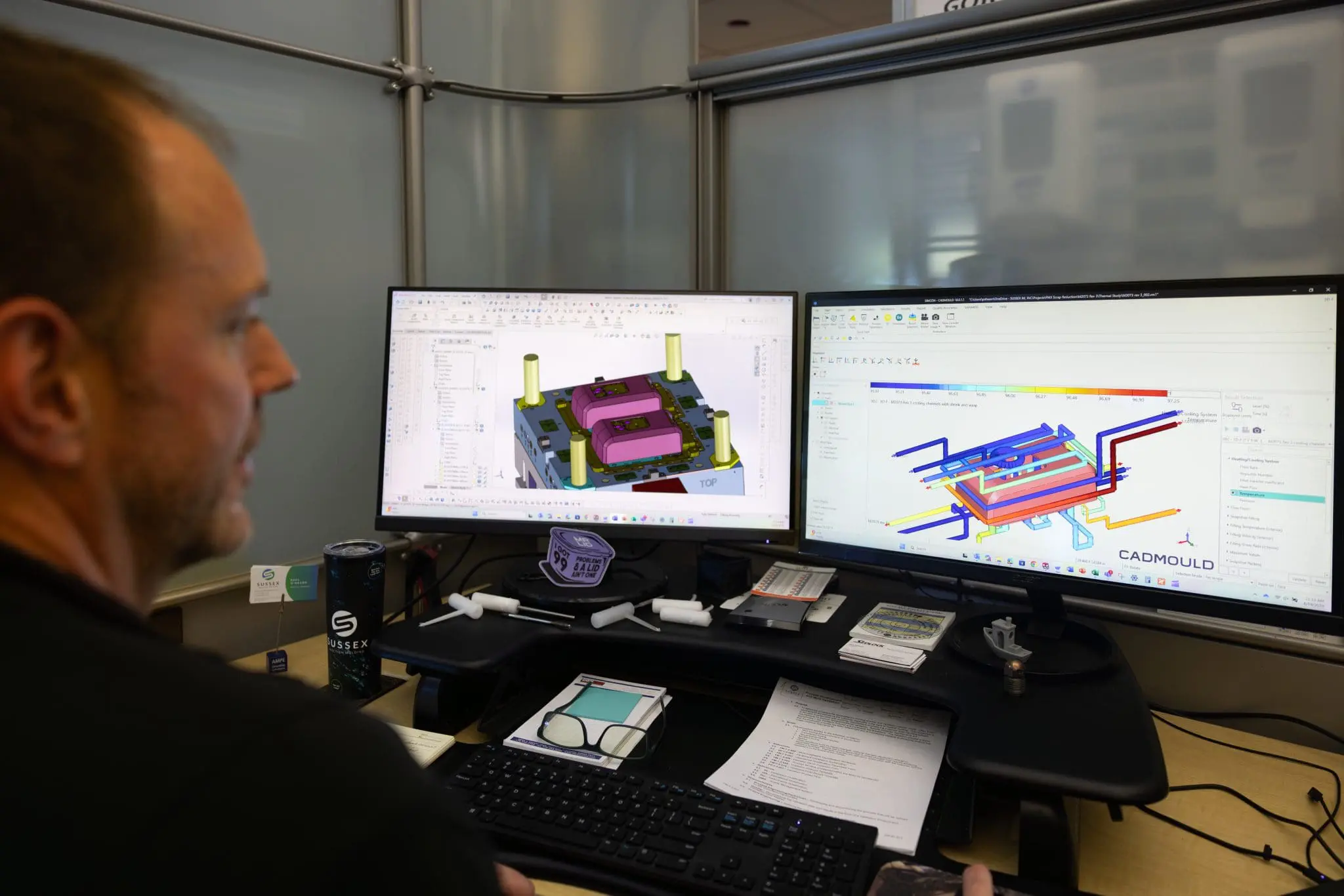
When a molded part runs into trouble, the problem usually didn’t start at the press. It often started much earlier, in a design detail that looked minor, a material choice that made sense on paper, or a tolerance that became harder to hold once the part moved into production. Small decisions have a way of turning into larger manufacturing headaches when they are not reviewed through the lens of real-world processing.
At Sussex IM, complex projects are evaluated with a wider view from the start. Part geometry, resin selection, tooling strategy, inspection requirements, automation, and downstream operations all shape what happens once production begins. A capable plastic injection company should be able to mold to spec. An experienced team should also be able to spot risk early and help prevent avoidable issues from gaining momentum.
Injection Molding Experts Look Upstream
Many production problems begin long before the first shot is ever run.
Geometry affects flow, cooling, ejection, and consistency over time. Material selection influences durability, appearance, chemical resistance, and cycle time. Tooling decisions affect repeatability, maintenance, and long-term cost. Assembly, decoration, and packaging also deserve attention early, since each one can influence how a part should be designed and molded in the first place.
Our Design for Manufacturing process is built around those connections. Part design, material selection, mold design, prototyping, mold flow, automation needs, and downstream handling all get reviewed with manufacturability in mind. Better launches usually begin with better conversations earlier in development.
A strong precision molding partner should bring more than machine capacity to the table. Clear feedback, practical engineering input, and cross-functional alignment often make the difference between a smooth launch and a long list of revisions.
Data Should Lead to Better Decisions
“Data-driven” can sound vague in manufacturing content. In practice, it should mean something simple: better information leads to better decisions.
Useful data helps answer the questions that matter most. Are critical features holding where they need to? Are inspection methods giving a clear picture of part geometry? Are the results staying consistent from run to run? Are issues being identified early enough to avoid delays later?
Our approach to quality control manufacturing is built around answering those questions with more confidence. Advanced inspection tools make it easier to validate geometry, reduce variation, and move from discussion to action with less guesswork. Stronger measurement also creates a smoother path from development into production, especially when tolerances are tighter or geometries are more demanding.
Advanced Metrology Supports Complex Parts
Complex parts need more than a quick visual check or a basic dimensional review.
Our advanced metrology capabilities help support more detailed validation throughout production. The Hexagon 7-10-7 Global Blue S scanning CMM collects thousands of data points through continuous contact scanning, giving a much clearer view of part geometry while reducing manual variation. Offline programming from CAD files helps prepare earlier in the process. Automated routines support consistency across batches. An integrated camera improves alignment and documentation.
Inspection reliability also depends on how the part is held and measured. Custom fixtures built with support from our in-house tool room help stabilize complex geometries during inspection, which improves repeatability and gives the quality team a stronger foundation for evaluation. Additional metrology tools support SPC, leak and pressure testing, force and load testing, and Micro-Vu measurement for projects with more demanding requirements.
In-House Teams Keep Projects Moving
Speed in manufacturing is not only about cycle time. Response time matters too.
Projects tend to move faster when engineering, tooling, automation, quality, and production stay closely connected. A fixture change, tooling adjustment, automation refinement, or inspection update can happen more efficiently when the right people are already involved. Fewer handoffs usually mean fewer delays.
Our in-house structure supports that pace. DFM, automation, molding, assembly, quality, logistics, and fulfillment all work together as part of one connected process. Automation plays an important role here as well. Systems designed and built in-house support repeatability, efficiency, verification, testing, and downstream handling tied to real production needs.
Better Partnership Reduces Risk Across the Project
When customers choose a supplier for molded parts, they are also choosing how a project will be supported once complexity enters the picture.
Good partnership often shows up in quieter ways: fewer revisions, clearer communication, better validation, smoother launches, and stronger control across secondary operations. Growth, transfers, and changing production needs become easier to manage when more of the process is connected.
At Sussex IM, the goal is to make complex manufacturing more manageable. Practical engineering support, advanced metrology, in-house automation, and full-service execution all play a role in that effort. Injection molding experts should bring clarity to difficult projects, not more friction—and that is the standard behind how we approach every project. Connect with Sussex IM to talk through your next molding challenge.